





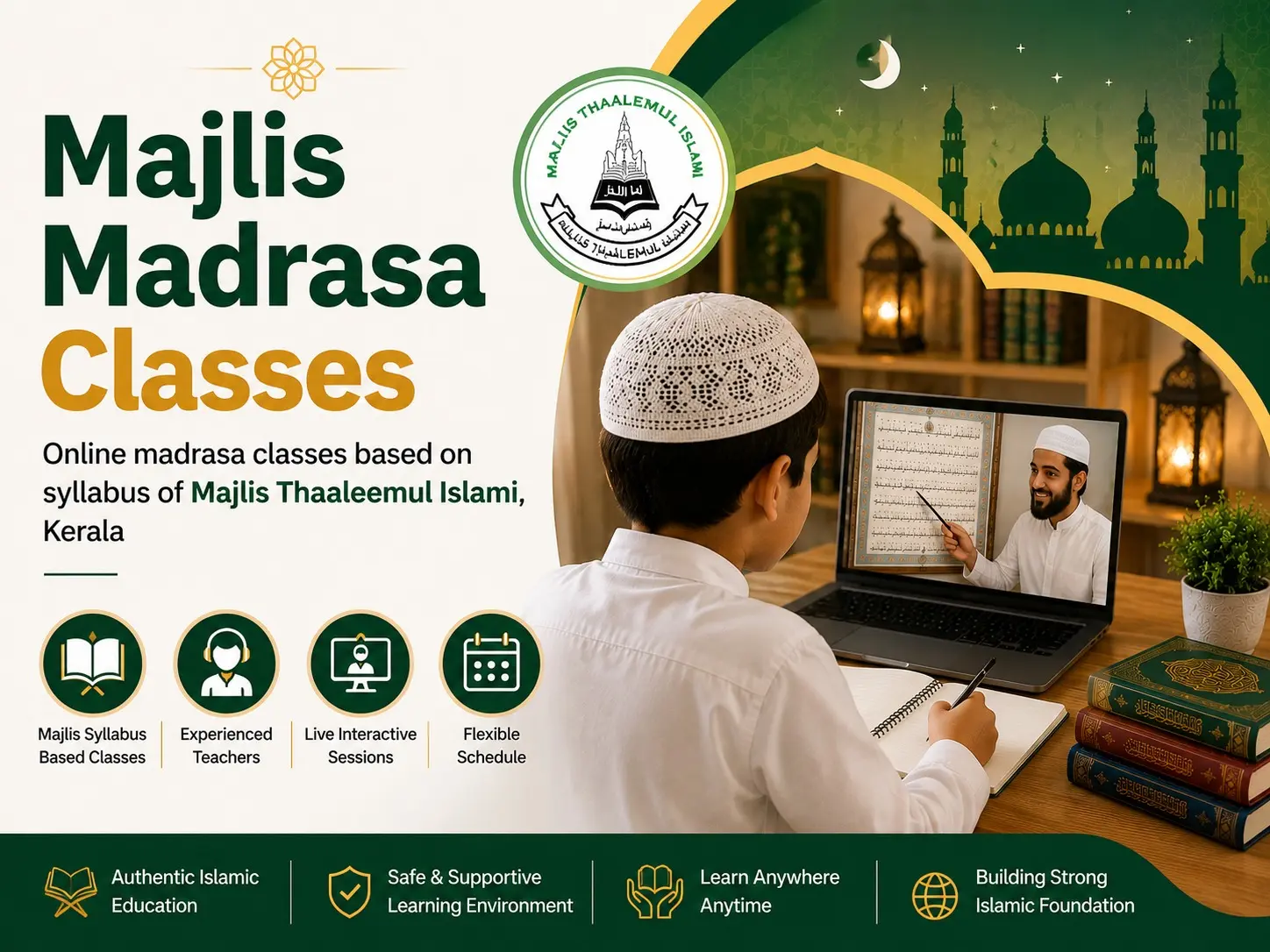
Online Madrasa Classes - Majlis Syllabus
Providing madrasa classes based on Majlisu Thaaleemul Islami, Kerala. Fram Arabic basic lessons to Quran and Hadees learning.
Course Overview
- Class range
- Classes I to IX
- Duration
- One year
- Level
- Primary to Advanced
- Language
- Malayalam & Arabic
- Schedule
- 2 sessions per week
- Course fee
- As prescribed
Subjects Offered
- Quran
- Arabic
- Tahjveed
- Quran with meaning
- Hadees with meaning
Who this course is for
School going regular students
Course features
Madrasa classes with all subjects as per KNM syllabus
What you will learn
Islamic basic lessons
About This Course
Online Madrasa Classes – Class-Wise Islamic Education with Personal Care
QXL Guidance Academy offers structured Online Madrasa Classes for school-going students from Class I to Class VIII, designed to provide children with a strong foundation in Islamic knowledge while they continue their regular school education. The programme follows a class-wise and progressive learning approach, helping students learn age-appropriate Islamic subjects step by step.
Classes are primarily conducted in 1:1 mode, with options for very small batches such as 1:2 or 1:3. This allows the tutor to understand each child's learning level, provide individual attention and ensure that the student receives sufficient practice and guidance throughout the course.
Class-Wise Syllabus for School Students
The programme is designed specifically for students studying in Classes I to VIII. Each class has an appropriate level of Islamic learning, allowing the student to progress from basic concepts in the lower classes to more detailed Islamic knowledge in the higher classes.
The syllabus can be prepared based on recognised Kerala Islamic organisation syllabuses, where applicable, or through a general Islamic education curriculum suitable for the student's age and learning requirements.
A student's previous Madrasa education and present level of knowledge are also considered. This helps the tutor identify learning gaps and provide additional support where necessary, while ensuring that the student continues towards the expected level for their school class.
Strong Foundation in Arabic Reading and Writing
Arabic reading and writing receive particular importance throughout the programme. Students gradually develop the ability to recognise Arabic letters, read words and sentences, understand basic word structures and write Arabic according to their class and learning level.
For younger students, lessons focus on building a strong foundation in Arabic letters, pronunciation, joining letters and simple vocabulary. As students progress, they can develop better reading fluency, writing skills and familiarity with commonly used Quranic and Islamic words.
This foundation also supports their Quran reading, helping students become more comfortable with the Arabic script and improve their ability to read Quranic verses correctly.
Quran Reading, Small Surahs and Tajweed
Quran learning forms an important part of the Madrasa programme. Students are guided in Quran reading and correct pronunciation, with Tajweed introduced progressively according to their age and ability.
Particular attention is given to short Surahs and selected portions of the Quran that are appropriate for school students. Students learn to read and memorise these Surahs with regular revision and practice.
Where suitable, the tutor also explains the basic meaning and simple lessons from the Surahs, helping students understand what they recite rather than treating memorisation as the only objective.
Students who are beginners in Quran reading can receive additional support with their reading foundation, while students with stronger Quran skills can progress towards better fluency, pronunciation, Tajweed and memorisation.
Selected Hadees with Meaning and Simple Explanation
The programme also introduces students to selected Hadees appropriate to their class and age. Instead of focusing only on memorising the Arabic text, students are encouraged to understand the Malayalam meaning and simple explanation of the Hadees.
The selected Hadees cover practical areas of a child's life, such as good manners, honesty, kindness, respect for parents and teachers, cleanliness, helping others, responsibility and other important Islamic values.
Through age-appropriate explanations and examples, students can understand how the teachings of the Prophet Muhammad ﷺ relate to their everyday behaviour and interactions.
Islamic Beliefs, Morals and Everyday Life
Along with Quran and Hadees, students gradually learn the basic principles of Islam and Islamic manners appropriate to their class.
Lessons may include essential aspects of Aqeedah, Akhlaq, Islamic history, Seerah and Islamic values, helping students understand their faith and develop good character.
The programme also introduces practical Islamic knowledge required in everyday life. Students can learn age-appropriate aspects of Fiqh and Ibadath, including topics related to cleanliness, prayer, fasting and other daily religious practices.
The emphasis is on simple understanding and practical application rather than making the lessons unnecessarily difficult for young learners.
Learning Through Meaning and Understanding
Our approach goes beyond simply completing a textbook. Students are encouraged to read, understand, practise and apply what they learn.
For example, when a student learns a short Surah or Hadees, the tutor can explain its meaning in simple language and discuss the lessons that can be applied in everyday life. Similarly, Islamic manners and Fiqh topics can be connected with situations that children experience at home and school.
This helps make Madrasa education meaningful and relevant to the student's daily life.
Learning According to the Child's Existing Level
Children joining the programme may come from different educational backgrounds. Some may have already completed several years of Madrasa education, while others may be starting their Islamic learning journey.
Therefore, the tutor first considers the student's age, school class, previous Madrasa education, Arabic reading ability, Quran reading level and general Islamic knowledge. Based on this understanding, the student can be placed on a suitable learning path.
A Class V student, for example, can follow the Class V level syllabus while receiving additional support in Arabic or Quran reading if there are gaps in earlier learning.
Personal Attention Through Small Online Classes
The programme is designed to provide personal care and direct tutor guidance. Individual classes allow the tutor to observe the student's reading, pronunciation, memorisation and understanding more closely.
For families who prefer learning with another student or a small group, 1:2 and 1:3 classes can also be considered. Keeping the batch size small helps maintain interaction and gives each student an opportunity to participate during the lesson.
Flexible Online Madrasa Education
Online classes make it possible for school-going students to continue their Madrasa education from the comfort of their home, without requiring daily travel to a physical Madrasa.
Flexible class timings can help families fit Madrasa learning around school, tuition and other academic activities while maintaining a regular learning routine.
Parents and students can also stay informed about the learning process through the dedicated QXL mobile application, where relevant information such as session schedules, previous and upcoming classes, syllabus, topics covered and learning materials can be accessed.
A Progressive Islamic Education from Class I to VIII
QXL Guidance Academy aims to provide a continuous and structured Islamic learning journey from Class I through Class VIII. The programme brings together Arabic reading and writing, Quran recitation, Tajweed, selected Surahs, Hadees with meaning and simple explanations, Islamic beliefs, morals, Seerah, history and practical Fiqh.
With a class-wise syllabus, personal attention and a learning approach suited to the student's level, children can gradually build Arabic skills, Quranic knowledge, Islamic understanding and good character alongside their regular school education.
Learn Islam according to your class. Build strong Arabic and Quranic foundations. Understand selected Surahs and Hadees. Grow in knowledge, character and faith—step by step.